Meet International Best Selling Author Scott Nicholson! (GLVWG “Write Stuff Conference)

by Tammy Burke

Whether you are just starting out as a writer or successfully published and in the field for some time, this year’s talent at GLVWG’s “Write Stuff” Conference is sure to help inspire, educate and enhance your writing life. During the next few weeks we will be posting a new interview with one of our very talented VIPs.

20140207-174750.jpg

First up is Scott Nicholson, international bestselling author of 20 thrillers. His bio is listed at the bottom of this interview and on our conference page.

Hi Scott,

As a prolific international bestselling author of 20 thrillers, (including The Home, After: The Shock, Liquid Fear, and Disintegration); in addition to writing 80 short stories, six screenplays, five children’s books, and three comic-book series, (plus songs and poems), it seems quite apropos for you to have such a strong presence at this year’s “Write Stuff” conference and pre-conference workshops.


Q: Based on the descriptions for your pre-conference workshops “Nurture Your Inner Hack” and “Re-imagining Your Writing,” it would seem you are constantly “swimming in an ocean of creative ideas.” Have you always been able to do this? Or is this something you developed over time?

Nicholson: I’ve always had more ideas than time to write them. Mostly, it’s just a habit developed over years, plus it’s just my nature to want to create things. I guess I am a natural born liar. Even when I was a musician, I always wanted to make up songs instead of learning some star’s song note for note.


Q: I understand you believe in embracing the digital age and with sales of 500,000 ebook within the past three years this appears to be a sound philosophy. Could you tell us what first made you a firm believer of ebooks and the digital age? And what advice would you have for other writers contemplating grabbing ahold of the digital age?

Nicholson: It was part inspiration and part desperation for me. After a few mass-market and small-press deals, the stream was drying up and I had to try something different. Luckily, the Kindle was just beginning to take off, so I jumped aboard and didn’t look back. Really, no matter what your route to publication, digital sales will be an ever-increasing part of your future, so it’s worthwhile to learn about the different devices and how readers are using them.


Q: Is it difficult to branch into international markets? Do other countries crave a different type of story than here in the states?

Nicholson: Well, marketing is the biggest challenge, no matter which route you take. Digital publishing allows you to reach the entire world, but translations are still important. I basically set mine up like a publishing company, finding my own translators, but other opportunities are arising, too.


Q: I couldn’t help noticing the phrase “Will trade words for magic beans” on your website. Am I correct to assume there is a story behind that…and if so, would you mind sharing it?

Nicholson: That’s just a play on “Jack & the Beanstalk,” as well as the fact that I am a serious organic gardener. My writing business is primarily to sustain my rural lifestyle. If gardening paid better, I’d probably spend all my time on it.


Q: I have to admire your tenacity. Based on your information on your website you experienced 105 rejections before your first story sale and then over 400 more before you sold your first novel. What was your inspiration for holding on when many would have given up?

Nicholson: Only the first two or three bothered me. After that, I realized it was just part of the process. I’ve learned to remove my ego from the process as much as possible. It’s nothing personal when your book doesn’t reach the right agent or editor, or doesn’t appeal to a certain reader. Just keep at it and you will find the right people.


Q: And finally, last question… Writing horror thrillers like “The Harvest,” which hit #1 on the U.K.’s Kindle horror list, you probably get asked if any of your ideas come from your dreams/nightmares. Would you mind confirming or denying that for us?

Nicholson: Not really. I don’t take horror seriously. It’s just a means of exploring certain questions and spiritual mysteries without being restricted by too many boundaries. To me, the big question is “Why are we here and what happens after that?” Horror, particularly in supernatural stories, is a good way to explore that question.

Thank you Scott for taking the time to let us get to know you better and being a part of our 21st annual Write Stuff Conference event!
______________________________________________________
Scott Nicholson is the international bestselling author of 20 thrillers, including The Home, After: The Shock, Liquid Fear, and Disintegration. He’s sold more than 500,000 ebooks in the last three years. Amazon’s Thomas & Mercer thriller imprint has released his Fear series and Amazon’s 47North imprint will be publishing the serialized novel McFall. Nicholson is also writing for a new Amazon media tie-in program. His ebook sales are projected to exceed $1,000,000 in 2013.

The Home spent six weeks on Amazon’s Kindle Top 100 bestseller list, selling more than 25,000 copies during January 2013. He’s been in the Kindle Top 100 with six different books in the United States and twice in the United Kingdom, reaching #12 with Liquid Fear. His horror thriller The Harvest hit #1 on the U.K.’s Kindle horror list. He’s also been in the Nook Top 100 twice.

Nicholson won the worldwide Writers of the Future contest in 1999 and was a Stoker Award finalist and an alternate selection of the Mystery Guild for his debut novel The Red Church. He’s also written 80 short stories, six screenplays, five children’s books, and three comic-book series. He’s served as an officer or volunteer in the International Thriller Writers, Mystery Writers of America, and Horror Writers Association. His website is http://www.hauntedcomputer.com.

_________________________________________
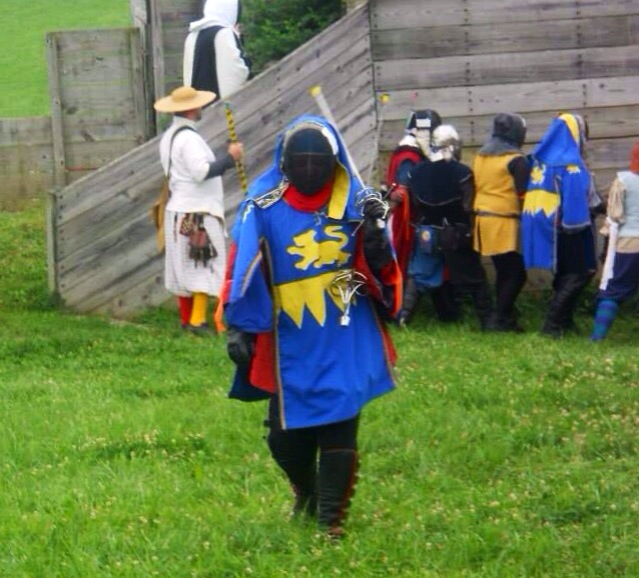
Tammy Burke, GLVWG member, 2011 conference chair and past president, has published over 300 newspaper and regional magazine articles and has interviewed government officials, business leaders, everyday folk and celebrities. Currently. she is in the revision stage for her first YA fantasy adventure book, the first in an intended series. When not writing, she works in the social service field and is a fencing marshal in the Society of Creative Anachronism (SCA).

Check out the GLVWG “Write Stuff” Conference blog at http://glvwgwritersconference.blogspot.com/
Confidence

Confidence.


Confidence
by Bradley Gunson

Confidence goes a long way. That is, until it blinds you.

Overconfidence makes you think your writing is flawless while confidence makes you strive towards making your writing flawless.

I first began writing with the confidence that only arrogance could bring. I had the “I can do better than that” attitude in regards to successful authors, when I had only just thought of the initial concept of a story. So I got to writing. I wrote the whole of draft 1, and it was fantastic.

Only it wasn’t.

I learned just how bad my writing was, and my confidence in it dwindled. Still, I persevered. I wouldn’t be defeated by that, I would improve, and become a great writer. So I learned, with the great help of the writing forum Mythic Scribes and its community, while writing through draft 2. About the halfway point I received very positive feedback and my confidence in my writing skyrocketed. Only this time, I had been humbled. I knew that I wasn’t the best writer ever, and I knew that my writing needed improvement. But it was good. From this point onwards I have written faster, better and I have felt good about it all. I am now proud of my work, and I believe that this time I deserve to be.

This is what a writer needs. This is what everybody needs. Confidence and humility. Confidence to strive to be the best you can be, and humility to know that you aren’t the best. Nowhere near the best. That’s what life is, striving towards your goals. Remember that pride isn’t a bad thing, despite the need for humility. You must find the balance.

A. E. Lowan puts this perfectly, “To be a professional writer takes 50% hubris and 50% humility. The mad audacity to publish and still accept you’ll always be learning.”

So if you are a beginner writer, without having learned the craft before hand, and you think your writing is amazing, it is likely that you suck. Oh, don’t worry. We all do at first. And that’s okay. (Better to learn early on how to improve, anyway, rather than after a full draft. Damn you draft 1.) Even if you write the worst thing ever to disgrace paper with its touch, it’s all fine. We all have to start somewhere, and there’s nowhere to go but up, from there.

As Chuck Wendig wrote in his blog post, “If you want to be a writer, then write. And suck. And write your way through the suck.”

My advice to any writer is to have people read your work. If you’re not confident enough to show people you know, then post it on a writing forum to strangers for critiquing. Learn through this how to improve and what to improve on. And do it. Keep writing, even if it’s bad. Keep improving until you are confident in your writing. Then improve some more. Don’t stop. No writer is beyond criticism, not even the most successful authors.

In any aspect of life, work towards becoming confident in something. Learn how to do it. Learn how to do it well. Learn how to improve. Strive to become better, and if you do become the best, keep going.

Records are meant to be broken, so challenge yourself, and keep improving.

[Repost] Blake Snyder Beat Sheet ….(along other things like Kathryn’s book)

Because I need to catch up with revising my manuscript — I was sucked into a reading frenzy (love HAVING a good book do that to me), I am going to share one of the blog posts I found to help simplify story structure. While there are many good writing books about structure, I’ve never seen a “cheat sheet” incorporate theme and a B story so I hope you enjoy it as much as I did.

Oh, if you are wondering what book put me behind (it’s outside my usual genre but the story grabs at a soul level and paints motion in a way I’ve never experienced before), it would be the recently released Art of Falling by Kathryn Craft.

http://skrishnasbooks.com/2014/01/book-review-art-falling-kathryn-craft.html

http://www.abc27.com/video?clipId=9785752&autostart=true

—————————————————————————————————
—————————————————————————————————

Blake Snyder’s Beat Sheet

The Blake Snyder Beat Sheet is the best plot structure template I’ve come across.

It breaks down the three-act structure into bite-size, manageable sections, each with a specific goal for your overall story.

See my review of the Save the Cat books by Blake Snyder (where the Blake Snyder Beat Sheet originated), and buy the book. It’s a great resource!

Below is an explanation of each beat. Please see how it works with graphic novels by visiting Graphic Novel Story Structure. Thanks!

THE BLAKE SNYDER BEAT SHEET (aka BS2)

20140201-104234.jpg
Opening Image – A visual that represents the struggle & tone of the story. A snapshot of the main character’s problem, before the adventure begins.

Set-up – Expand on the “before” snapshot. Present the main character’s world as it is, and what is missing in their life.

Theme Stated (happens during the Set-up) – What your story is about; the message, the truth. Usually, it is spoken to the main character or in their presence, but they don’t understand the truth…not until they have some personal experience and context to support it.

Catalyst – The moment where life as it is changes. It is the telegram, the act of catching your loved-one cheating, allowing a monster onboard the ship, meeting the true love of your life, etc. The “before” world is no more, change is underway.

Debate – But change is scary and for a moment, or a brief number of moments, the main character doubts the journey they must take. Can I face this challenge? Do I have what it takes? Should I go at all? It is the last chance for the hero to chicken out.

Break Into Two (Choosing Act Two) – The main character makes a choice and the journey begins. We leave the “Thesis” world and enter the upside-down, opposite world of Act Two.

B Story – This is when there’s a discussion about the Theme – the nugget of truth. Usually, this discussion is between the main character and the love interest. So, the B Story is usually called the “love story”.

The Promise of the Premise – This is the fun part of the story. This is when Craig Thompson’s relationship with Raina blooms, when Indiana Jones tries to beat the Nazis to the Lost Ark, when the detective finds the most clues and dodges the most bullets. This is when the main character explores the new world and the audience is entertained by the premise they have been promised.

Midpoint – Dependent upon the story, this moment is when everything is “great” or everything is “awful”. The main character either gets everything they think they want (“great”) or doesn’t get what they think they want at all (“awful”). But not everything we think we want is what we actually need in the end.

Bad Guys Close In – Doubt, jealousy, fear, foes both physical and emotional regroup to defeat the main character’s goal, and the main character’s “great”/“awful” situation disintegrates.

All is Lost – The opposite moment from the Midpoint: “awful”/“great”. The moment that the main character realizes they’ve lost everything they gained, or everything they now have has no meaning. The initial goal now looks even more impossible than before. And here, something or someone dies. It can be physical or emotional, but the death of something old makes way for something new to be born.

Dark Night of the Soul – The main character hits bottom, and wallows in hopelessness. The Why hast thou forsaken me, Lord? moment. Mourning the loss of what has “died” – the dream, the goal, the mentor character, the love of your life, etc. But, you must fall completely before you can pick yourself back up and try again.

Break Into Three (Choosing Act Three) – Thanks to a fresh idea, new inspiration, or last-minute Thematic advice from the B Story (usually the love interest), the main character chooses to try again.

Finale – This time around, the main character incorporates the Theme – the nugget of truth that now makes sense to them – into their fight for the goal because they have experience from the A Story and context from the B Story. Act Three is about Synthesis!

Final Image – opposite of Opening Image, proving, visually, that a change has occurred within the character.

THE END
——————————————————

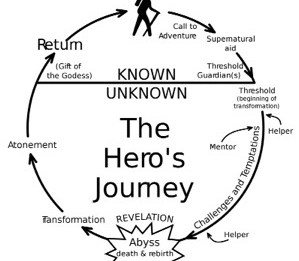
Hero’s Journey picture used from http://paperhangover.blogspot.com/2011/06/writing-101-story-circle.html

Wrangling Interconnectiveness…Or No, We’re Not All Going To Get Along

20140125-181750.jpg

The world and its events are interconnected now perhaps more than any other time in history and it is remembering this interconnectedness which helps drive a good story plot and produce believable character development.

I’m going to bring up one of my groups I spend many predominately non-writing hours (Predominately because I do use it occasionally for research and ideas). This group is called the Society of Creative Anachronism or SCA. Okay…so what is it and why is it important?

Well, it is an international nonprofit group stretching throughout North America, Europe, Austalia, etc. and strives to recreate the best of the medieval world from the fall of Rome until around 1650. The people recreate, train, research and play with the various disciplines from combat (this it the place I fence) to the finer arts such calligraphy, leather working, brewing, costuming, and countless other application of things.

A fantastic group which I will now use as an example. This anachronistic band of tens of thousands find themselves competing with computerized game systems and battling the affect of rising gas prices which is bringing a trend of declining membership coupled with the need for a fresh infusion of new blood.

There is a current discussion going on on how to fix this. I bring it up just to show outside influences bring effect whether you want it or not.

There are no isolated happenings as I discovered when I moved from high school ‘point in time’ history with its focus on date memorization and no real context to – POW – college with viewing happenings in its much larger format. Such as ….What was happening politically? Economically? What was happening in the popular mindset? What other events had just gone down? What were the fears? The hopes?

These are great tools where you can even theorize and project probable happenings in today’s near future.

You might ask what does this have to do with writing?

Everything!

Unless you have put them there, how many protagonist live on a deserted island? Who and what have influences on them? Do you know why?

To back up just a little, my story is set in an approximate 14-15th century European-like setting which means I’ve considered styles of communication, the sciences, economics, faiths, popular mindsets, etc. I have gone through bouts of analyzing every story thread to wrangle every drop of influence to cavalierly striding forward while muttering that the reader doesn’t need to know ‘that’ so perhaps I won’t have to either.

I’m closer to admitting it’s a real art form identifying all the important influences to a character or a situation because words on the page not only paint things directly but it swirls with subtle undercurrents as well.

Going forward now. As I’ve been working on my manuscript, I’ve had an interesting time figuring out how my characters get from one marker to the next, shuffling through what is truly important to the story and what is superfluous, and also what to reveal when. Part of this learning curve is my insanity of not writing one complete book as my first one but an epic series. (I’m choosing not to include the bad novelette I wrote when I was much younger about the runaways living in hidden apartments in the sequoias).

Anyway, this week, as I have been going through major revisions…I was able to identify where my protagonist’s love interest’s story arc felt incomplete.

(Yes, it was in the middle…imagine that)

Well, I’m happy with the set-up, pleased with the ending, enjoy the suffering he (Mathias) faces, and even happy with his external conflict with the leader of this Mithraic religious group and the puzzle and battles with the wererats but there was a point where Mathias just disappeared. I couldn’t even feel his pulse which was weird because I know I hadn’t killed him.

Well, Mathias (or his corpse) wasn’t talking nor any of his buddies or enemies or even his pegasus so I said fine. I decided to go back and look at his family history.

I went on location to one of the prettier rooms in my local library and sat down with my various timelines. I figured out all the people who are his most important/influential (good and bad)…parents, friends, enemies… and delved into what probably happened to him in his younger life along with the mindsets of his most influentials and why did they have them.

It was exciting and grueling…if you haven’t experienced this weird combination you can opt to shake your head…but I ended up with some real diamonds.

I now totally understood Mathias’ mindset of why he is extremely hesitant to admit love, why when he feels the pull of “more than attraction” he flees and why it continuously haunts him.

I’m excited about revising certain scenes this week because I have the tools to make them stand out and not just Mathias (POV character 2) is more 3-dimensional and he gave up some important secrets. This exercise also showed me unexpected interconnectedness with my protagonist, Aunia, and my third POV character, Wendalin.

Anyway, Happy Writing to you all! And please feel free to share what exercises you might be using to get to the most important interconnectedness in your stories.

What can Fairy Tales Teach Us?

20140118-010133.jpg Fairy tales. I, like so many others through the ages have had these first stories dig deep into my heart, first by the “hearings” and now by the “tellings.” (‘Fore fairy tales ARE meant to tell and not necessarily made to show) Cinderella, Rapunzel, Blue Light, Little Tin Soldier, The Frog Prince… well maybe not the Little Match Girl, that one always makes me cry but the story still resides in my library as much as the others. Dark tales, that’s what fairy tales were before they were sanitized.

Perhaps this modernization has lead those not actually familiar with the tales to think the fairy tale world is all light and fluff. They weren’t. Even as a child, I never wanted to actually STAY in that world. Are you kidding me? The risk of being eaten or murdered, mutilated, beheaded, incinerated, neglected, abused or other unpleasant things were quite high. These lands have places where you might be required to slice off your own pinkie finger in order to finish a ladder to reach your beloved… and if you were naughty you could have your eyes pecked out or made to dance in iron shoes. How many young princesses lost their voices for years while watching, usually their brothers, be transformed into beasts or fowl? However, in fairy tale land the payoff IF you survive and you are GOOD and a little lucky, then you got a happy ever after…supposedly without any post trauma stress disorder syndrome.

What magic do these dark creations with its cookie-cutter protagonists and antagonists, woven with repeated thematic story lines have? And why do they work?

Is it because they bear a message, perhaps a moral, and offer children a means to problem solve and build emotional resiliency? Well, you can easily google studies that will point affirmatively that these dark tales work in a child’s psyche as a means to explore the dangerous and the distressing in a reasonably safe environment. I mean, the big bad wolf does not usually leap from the book to get you, does he? And the reader, a child or perhaps an inner child or two, will experience (through the story) that by being good, kind, and clever you usually can find a way to overcome the obstacles even if truly horrific things are happening such as parents abandoning you in the woods, having to throw a fake good samaritan who had wowed you with a candy house into the oven to protect yourselves from the slaughter, or discovering your husband has been keeping his murdered wives up in the room he’s forbidden you to go in.

See dark tales… Interesting fact. When things get too sanitized and say the witch doesn’t die at the end of Hansel and Gretel children have more nightmares. Why? Well, the witch is still out there…and that’s frightening. The story you see is not yet complete and add a child’s fertile imagination… Begs the question, as a reader yourself, do you get frustrated with stories with loose ends or do you like it that way so you can keep imagining?

These stories also work MOST…. (writers cue for attention) …because they represent the building blocks of archetypes. Characters, story quests and setting itself are all archetypes. After all there are probably dozens if not hundreds of Snow White story versions told throughout the world. Same character, same quest with only minor differences. How many stories are in a castle? In a child’s room? Or in the woods? If I say Rupunzel do you immediately think tower and loneliness and the Three Little Pigs do you feel a big breath and the foolhardiness of building with substandard materials?

Does this mean I’m suggesting the story you’re writing should be able to be plugged into a Grimm’s or Hans Christian Andersen tale? I would hope not…or at least not usually. And I’ll explain why in the next paragraph. But the case is… people are hardwired for stories and these fairy tales make up an important part of our “cultural language.” The wisest course would appear to use archetypes’ skeletons and then flesh it and dress it into our own story’s uniqueness because using aspects of the archetypes taps into that soul deep communication.

But it’s important to remember in fairy tales much is missing… for example, when Little Red Riding Hood is entering her grandmother’s house we don’t know if the basket feels heavy in her hand, or if she really picked the flowers along the path or she just pretended and took a nap, or if she waved to the woodcutter on the way because he was related on her dead father’s side or ignored him because he smelled like garlic. We don’t know if she was afraid of the wolf or if he reminded her of her first puppy which her mother made her give away. We don’t even know if she’s hoping her grandmother will give her a huge hug and a new hood. But in fairy tales it doesn’t matter because these details can be added or changed at a whim. What’s important are the main elements like… grandmother what big ears you have..what big teeth you have. Can you imagine how many of us could get plopped into a fairy tale’s archetypical spot and the tale would proceed with little change.

Hence the fleshing and dressing… For example, what happens if Red is a teenage boy, or the location is the moon or Red is really a werewolf herself? These would be in the making for a probable interesting twist to an archetypical story. Also bear in mind, traditional fairy tales are stories at the simplest level. They bear no subplots or subtexts. They could be likened to mother’s milk, nourishing but eventually we grow to need bread and meat.

The most important thing in a story though is to be able to make that connection with the audience…to have them take away something, some sort of emotional experience one gains by journeying with the protagonists and experiencing the changes and revelations along the way. After all, plot is a series of events but story…that is what happens, the affect and changes on a person as the events unfold.

Well, fairy tales contain “story” by having the reader project much of him or herself into the hero/archetype. We imagine Hansel and Gretel are thrilled when they find their way home and are reunited with a now presumable loving father, that Cinderella is happily married since she’s out of poverty with someone who treats her well, that Red is grateful to be rescued from the belly of the wolf and will be more careful about strangers, or at least the toothy kind, but gets to live happily ever after with her grandmother…or even that the one-legged tin soldier had a brief bittersweet moment of happiness when he realized the toy ballerina loved him enough to join him in the flames. We get all this by how we would feel in those situations.

This may suggest that to create the greatest emotional reach to our audience we should create just enough of an elegant skeleton so our reader will project their own emotions through our characters. It bears consideration. After all, I don’t think I’m the only who finds it difficult to get into stories which leaves me unemotionally moved.

What are your thoughts?

The Pen….Psychologist’s Couch or Pom-Poms?

20140111-103434.jpgIs it better for a writer to be a therapist for his or her protagonist or for the villain?

Seems like an easy thing to fall into…. you know… be a therapist by harvesting all these juicy emotions and situations where real life turns on its ear and the emotional fall-out needs some sort of silver lining. Savor a bit of that “doctor, heal thyself” mentality. After all, emotional coin is what’s needed to purchase a character’s fleshing-out. You know, pump the air into a flat character.

And We can monitor their development. But we cannot be kind.

Instead we can note how throwing barriers and frustrations against our characters cause them to react and evolve. Yeah. I suppose a therapist is out of the question. Storytellers should be psychologists albeit sadistic ones. Yes? And then the characters clam up when we “pop them on the couch.” Guess they have our number –oh reason number 5 for writer’s block.

How to get the characters talking again… I know. Change of venue…perhaps storytellers do best from hanging out in their villain’s lair knocking back a few drinks with the big bad laughing at the situation the naive/stupid/pretentious protagonist is in and what he/she doesn’t know. Perhaps we, the storytellers can drop in and gossip with the minions to get the drop on what a real mental case they think super-villain is BUT the payout will be better than their meager lives would be otherwise. Maybe we would pop over and commiserate with our protag’s sidekick about how poorly things are going with her friend, Protagonist wonderful, and remind her she may be neglecting her own life. I suspect by the time we get back to our protag we can revel in the feeling of being a two-faced backstabber who is sure to cause conflict on every page.

Does this mean we’re more like scientists not only observing the human equation but holding experiments? Interesting thought. We could invite all the cast to an impromtu happy hour and take note who socializes with who, who avoids who, who confronts who, who flirts with who and who hides in the corner. What happens in no-crap situations like if romantic interest gets hit with the tab or bartender hands villain a box of kittens.

(What would be the takeaway for an exercise like this?) A stronger idea who your characters are, who they want the world to believe they are, what their failings are, what their strengths are, and what the optimal change would be. We’d know how each one would react to disappointment, frustrations, hairy situations AND also how they react to each other. We would have already put thought into why they do what they do. We could inform other storytellers that no one reacts in a vacuum, there are reasons for what the characters are doing for all to see and it doesn’t always jive with what they are feeling inside their skins. (See, this is great for making for external/internal conflict.)

And one more exercise dear social scientist for dissecting the psyche. Have you considered how you have changed in the last year, five years, 10 years. What was your turning point? Your spouse’s? Your parents? Your best friend? Afterall, how your protagonist and other POVs evolve are critical to story so why not grab some real life inspiration?

I’ve been working on various ideas on how to further flesh out my story, make it real, and while the process is exciting I can’t get over the other idea of why stories are important. It isn’t just for the creative outlet but it is to connect with others. I, like many others, want to make an impact, to help/inspire/guide in some way. And that happens if and when we can touch a reader who can relate to our protagonist. Perhaps we can help generate the thought ‘If protagonist extraordinaire could get through xyz then maybe I can too.’ Or perhaps we can generate the desire to do better than protagonist unlucky by causing the reader to think “I can do better than that with my life” by seeing what NOT to do.

So I’m going to wager this — storytellers are not the therapists for society but more like the mentors and cheerleaders (or doomsayers). We find a way to connect without being preachy and we can change the world.

What’s your thoughts?

Organizing the muse

Face it… to be creative is to be chaotic even if your muse follows more to a plotter’s dance than a pantser’s one and it’s great BUT what happens at the end of the day when you’re holding a giant ball of snarled creativity aka your beloved manuscript and wonder despondently how you will unsnarl the tangled story threads into a neat but still dynamic semblance of greatness. You know, villian B commits atrocity C because sidekick W ran off with family member 3 but only because Plot line yellow was rising and caused Protag almighty to realize desire to discover 7x was groomed because descendant of family member 3 is helping Villian B to destroy…. And protag’s inner desires is to be the savior of area terminal because family member 4 stood by while family 3 ran off and did nothing causing protag to be less confidant in… but protag’s strengths are…. but villian…. This conflict leads to this interaction leads to this conflict leads to internal upheaval to Villian A leading to external upheaval of area terminal but Protag is distracted by shadow elusive pitching….. And why did family member 3 run off in the first place? Is it relevant?

Exciting when the snarls as they untangle lead to unexplored juicy areas or ring with that a-ha! “This so works” moments but then again, how does it feel when the poor muse has drifted away causing or perhaps instead lending to the pulsing super writer mind flattening into the “I’m so fried, it hurts” crispy brain.

This loop has continued to astonish, excite and infuriate me again and again. I’ve walked away disgusted and discouraged and find myself back at it again but with more tools under my belt.

Tool #1: An excel spreadsheet of scenes. I found the format too rigid and I got lost in who, where, how. However, it did let me plot the first draft,

Tool #2: Snowflake Method. Great method by the way. If you want to know more about this technique visit http://www.advancedfictionwriting.com/articles/snowflake-method/ Got a more cohesive idea of the general shape of the story but writing less words for me, for some insanely torturous reason that escapes me, is harder than writing more. Plus I have this problem with delayed instant gratification.

Tool #3: Timeline. This helped me a lot and I use this ALL the time. I don’t have to write linearly but it is easier to know what is going on by knowing what happened linearly. This was one of the tools I learned from James N. Frey workshop. For those who don’t know, he’s the author of the “How to Write The Best Damned…” book series, I have a timeline for overview of everything and then timeline for each main character. This timeline has also helped me with figuring out external and internal desires for my main characters which goes into my….

Tool #4: Character documents. These docs, which I keep on Evernote, allows me to free associate when one of the characters decide to divulge something to me and I don’t have a place to put it on a timeline. This snippets and nuggets sometimes show up while I’m writing as improved fleshing out of characters on page and creating better conflict, flashbacks, subtext, etc. It is a loose format that my creative side likes without getting lost on a scrap of paper and me wailing….where did that go? Or worse, forgetting a really good idea.

Tool #5: The Add-In document. This one came about because I was looking to refine keeping track of the boiling down, pumping up micro-tension revisions. Many of us know we need to look at each scene with what the protag wants most in the whole world — externally and internally, what ideas/actions/characters/situations can be combined, what can be sheared, what needs to be added, etc. But my question continually turned up as “how do you keep all those ideas straight and accessible when a free flowing story thread presents itself AND moves off the page you’re working on through various chapters?” And this is when the Add-In/Change document was created –again on Evernote. I can put these thoughts into some semblance of order and drop in as needed. I currently have 3 such docs — Act 1, Act 2 and Act 3. I think this one is a keeper. (I use “comments” in the manuscript and then copy the comments into this doc)

Tool #6: Leverage of technology. I don’t always have the option of sitting in front of my laptop during the day and I have found a way to have technology work for me with sites such as Evernote which I can access anywhere from any computer. Another option is smart devices. I use Siri to transcribe quick notes on the fly and I can export the notes to whichever format I’m working on. I revel in this kind of freedom because it allows me to range from tinkering with words to producing a wash of fresh ideas.

Finally, and this tool is good for a variety of reasons…
Tool #7: Encouraging the writer within and learn from others. This is one I will be working on this year as I sorely miss my writers’ group. Writing alone is isolating and I feel deeply that it is important to have that connection with the writing world…a place outside your own head. I definitely recommend joining a good group, if you can. Face to face, I find, is best but online or at the least, through books or blogs will allow you to learn and take inspiration from others.

I’m hoping as we enter this new chapter of 2014 some of this rambling might help others discover techniques which may work for them. I’m also curious to learn, in this instance, organizational tools other writers use and I wish all the Keys to the Universe for their writing.

Mastering Multiple POV in 6 Steps – Fantasy Writing Discussions November 11, 2013

It’s helpful seeing how other writers tackle thorny writing issues such as multiple POV – hence my repost here. My personal advise for first time novelist is to pick a simple format such as a single POV and single not-a-series book. However if you are “crazier” than the average writer then I say “full steam ahead,” don’t give up, and learn as much as you can as you go because it’ll be a long hard road.

The below post is from Mythic Scribes. Hope you enjoy.

Fantasy Writing Discussions November 11, 2013.

Eddard Stark
Multiple POV storytelling has a bad rap.

Sure, the practice of splitting a single narrative across multiple characters’ perspectives has a long history. And its popularity continues to expand as our society grows ever more distrustful of singular truth, in favor of individual realities.

But multiple POV writing is not without its critics—and some of them are quite loud. Many writers and readers complain about poor or confusing execution. Others cite their traditional literary tastes. Why hop between multiple character’s minds, they argue, when you could tell a story more simply through one pair of eyes?

Points taken.

But let’s say you’re a fantasy writer who is (like me) hopelessly attracted to this kind of complexity. Maybe you admire Martin’s A Song of Ice and Fire, or Rothfuss’s Kingkiller Chronicles, or maybe Larke’s Stormlords. Each series (and many others!) uses multiple POV differently. Each has merits and foibles. And each inspires a sharp audience reaction—either adoration or dislike—in part for its perspective choices.

Multiple POV writing, then, is not for the faint of heart.

Personally, I’ve been fascinated with this approach my entire career. I also struggle to write it well. But after years of study and experimentation, I recently experienced breakthroughs that helped me start to tame this unpredictable but powerful beast.

Here’s how I craft a multiple POV novel, from start to finish:

Step 1. Determine why you need multiple POVs.

Like any other writing decision, multiple POV is a choice with consequences. I think some writers choose it just because it’s harder, or because their favorite author uses multiple POV. These are fantastic inspirations, but inspiration and intent are two different things. Some stories might be better served with a single viewpoint. So make sure your story really warrants multiple POVs before you start writing.

I’d list all the possible reasons to choose multiple POV, but this thorough blog post has done it already. (For my part, I choose multiple POV because I’m a cinematic writer with a strong alignment to the intertwined structure of TV drama. I’m also fascinated by the unreliability of individual perspectives. These are two great and common reasons to choose multiple POV.)

Step 2. Design your plot for multiple “drivers.”

Once you’ve settled your own reason for writing multiple POV, it’s time to examine your story. Here, you’ve got two choices. Either you cover a single set of events from different perspectives, or you create a multiple sets of events that deliberately move from place to place and character to character, without much “overlap coverage” of any one incident.

Personally, I choose the latter because I’m writing adventure with lots of action and mystery. Writers interested more in drama, romance, or fantasy of manners might choose the former approach.

Step 3. Assemble the appropriate cast.

Once you know what kind of plot you’re working with, it’s time to determine how many (and which) POV characters you need. Will three suffice, or do you need four? Why is each POV truly necessary? Will each POV character have a complete arc of transformation, a mini “hero’s journey” of his/her own? (I advocate this approach, personally.) Or will they simply appear as needed to move the plot along?

Most writing coaches recommend no more than three to five POV characters for writers who are just “getting the hang” of multiple POV storytelling. But honestly, there’s no hard and fast rule. Just don’t take on a casting burden you’ll later regret!

Step 4. Decide whose POV best carries each scene.

Personally I find the previous steps easy, but determining specifics is a bit more challenging. My own multiple POV novels were a mess at the scenic level until I did an analysis of scenes in A Game of Thrones (the novel). That’s when I realized the true key to scenic decision-making: Not every POV character’s scenes should be IN their POV.

For example, the first time we meet Eddard Stark, we see him through the eyes of his son Bran. This is an ideal POV to establish our concept of Eddard as wise, just, and serious about his lordly duties. Eddard’s own first POV chapter comes not long after. But if we had met Eddard in his POV first, instead of Bran’s, how might our first (and most important) impressions of him have been different?

Sometimes, it’s a toss-up about whose POV a scene should be in. In these instances I ask myself, “Who has the most to lose in this situation?” This question usually makes the best POV character obvious.

Step 5. Make each POV character unique.

Each POV character should be a living, breathing person. They should talk, behave, react, and think like themselves. After all, the magic of well-done multiple POV is its ability to shatter our comfort with one perspective. So make sure we really feel like we’re getting more than one!

Can you make us weep for the humanity within your villain? Can you grip us with a naïve child’s downward spiral into a street-hardened thief? What about the creature shunned by its human counterparts, or the political refugee struggling to “pass” as a citizen?

If all four are in the same book, there shouldn’t be any question as to whose chapter the reader is in, based purely on how the prose is written.

Step 6. Reduce to the minimum viable story.

Revising a multiple POV novel adds a few complications to an already-complex process. For one thing, you’ve got to ensure all those ornery POVs are working in harmony, and I guarantee you, they won’t “heel” after just a draft or two.

So add a POV pass (or two!) as a check on your revision list. Do you have all the POVs you need? Are any missing? Does each POV character’s story open in the right place (their own POV or someone else’s)? How unique are their psychologies, styles, and voices? Revise all the POVs together, and also revise each of them separately. You should strive to finish with no story gaps but no excess baggage, either.

Multiple POV writing sounds like a lot of work. And it is. Not everyone will agree with your choice, either, if you adopt this approach for your next project.

But if multiple POV is right for you, then wow, is it ever worth the effort! Crafting a compelling, complex story that celebrates the many, instead of the one, is an experience like no other.

I hope you find these tips helpful, but don’t forget to share your own! Have you tried multiple POV? How did it go? Which writers do you think have mastered multiple POV?

PS – If you’re doing NaNoWriMo this month, I’d be honored if you add me as a writing buddy under JourneyCraft.

Lisa Walker England writes a weekly illustrated fantasy serial, blogs about the art of storytelling, and develops sequential multimedia properties with two artist friends.

Laboring the Story Soul

20131018-104051.jpg

What is it that makes a writer a writer? Is it the burning desire to tell a story? Is it the burning desire to understand humanity? Is it the burning desire to understand self? Or is it merely a way to escape? (From the burning!)

I would wager to say escaping while perhaps true in the short term would be likened from leaping out of the frying pan… Writing is a lot of work.

Burning desire to tell a story – that’s what I’m to go with. And why do I have a burning desire to tell story? I’m voting that I’m still on the road of self-discovery or I haven’t come to terms with not knowing all the whys.

Do you know why you have a burning desire to tell a story? Or even if you don’t write, what is it about story that attracts you? We humans seem to be hardwired for story.

But my latest path with self-discovery and story is a reformation on things I knew but perhaps more on an unaware deep level.

I could go into all the details of circumstances, mostly external ones, bringing me to an internal epiphany but that would be a novel, at least, in itself.

Let’s just say it’s difficult sometimes giving it your best Pollyanna effort when the world doesn’t feel like it wants to cooperate in the least but I suppose that’s what spotlights true determination or failure,

We are greater than the sum of our parts. How long before we really know, like deep in your bones, know that one.

I would say that is easier to remember when we see it in others. It isn’t always easy when we looking inwards but we get to experience all the turmoil. Put both together (seeing it in others and feeling it your self) and what you have is a protagonist in a story who allows us to travel with – no, become one with him/her/it.

For you writers how do we get there? How do we build/create/spawn this magical transport?

You know this, don’t you?

It has to come from the deepest, most secret, maybe even hidden from yourself place that you possess. It comes from that place you hide from the world. It means you have to be brave and well, more than bare your soul. And that image took me straight to the kitchen with a bowl full of “souls” and the cook busily preparing them for preferential taste for her dinner guests…?

I suppose also being a writer means finding a way to use these weird weird images that come to you.

“Hi. Welcome to the inside my head – yes, it is kind of scary in here. Didn’t mention writers are crazy?”

Anyway, questions to ask to help you create this magical transport:

-Have you ever wondered whether your own life has a theme? what would it be?

– What draws you? Why?

– What is your coping device?

– do you think any of it is because of nurture versus nature? Does it come from someplace else?

Well… I have some crumbs to feed my magical transport so I’m off to my manuscript

Happy Writing! (Or reading) and may the story come off the page.

Everything you need to know about Hashtags by Annie Neugebauer

An informative blog on hash tags.

(Re-pressing from the Writer Unboxed blog. By Annie Neugebauer)

Everything You Need to Know About the #Hashtag

If you spend any amount of time on the internet, you’ve probably seen people using words or phrases with pound signs in front of them, #like #this. On Twitter, this is called a hashtag.
Putting that symbol in front of a word turns it into a searchable link. In other words, you can then click on that #hashtag and see the tweets of everyone else also using it. It’s a way to find people talking about the same thing you’re talking about; it creates a larger conversation all in one feed.
How to Make One
There’s no trick to making a hashtag. You don’t have to register it, log it, or reserve it. All you do is type it, and Twitter will automatically turn it into a clickable search term.
Start with the pound sign (#), but don’t include any spaces or special characters (?’!&, etc.). Spaces and special characters will break your hashtag.
So if you want to use the phrase “author’s choice,” you would need to write it as: #authorschoice or #AuthorsChoice . Neither #author’schoice nor #authors choice will work properly. Some people use caps to make new words easier to read, but this is optional.
Numbers are okay, but don’t start your hashtag with numbers. #2013Conference won’t work. #Conference2013 will, though.
And lastly, don’t forget to keep it short. Hashtags do count toward your 140-character tweet limit, so the longer they are the less space you have to add other text.
Best Ways to Use Them

First, check to see if the hashtag you want is already in use. Depending on what you’re going for, an already in-use hashtag could be a good or bad thing. If you just want to join a larger conversation, you probably want to choose a popular hashtag with a fast turnaround (lots of new tweets coming out). If you’re trying to promote a contest or new chat, you’ll want a hashtag that no one has been using lately to help keep out irrelevant tweets.
Hashtags are great to start a conversation if you have enough clout to make it work. Say you want to hear what people have to say about a new trend in publishing. You can gather the talk into a central spot with a hashtag.
Other useful options include running competitions, like #PitchMadness, starting open chats, like #WritersRoad, or building buzz for your own book by creating a specialized hashtag for fans and supporters, like my friend’s use of #OMGen.
You can also, of course, jump into any existing conversations, including trending topics. The list of trending topics changes regularly, and is on the left side of your timeline on the Twitter website. If any of these topics are relevant to you, you can join the talk on those extremely popular hashtags. This can be a good way to reach more people, but it’s also easy to get lost in the hub-bub, so don’t spend too much time trend-chasing.
All of these are great ways to find and gain new followers. The idea here is to discover people who are talking about the same things you’re talking about. Hashtags can also help relevant peeps (your target audience, if you’re talking about the right things) find you.
And finally, hashtags can also be just for funsies. (Yes I said funsies. Deal with it.) Hashtags can occasionally get ridiculous. Because of this, people like to make fun of them with #SarcasticHashtags. You can use a hashtag to add a punch line to a tweet, clarify your joke, poke fun at yourself, or whatever else might make people giggle. There are also occasionally silly hashtag games that pop up, like #boozebooks.
Worst Ways to Use Them
Using too many hashtags in one tweet makes your tweet look like spam. A single well-chosen hashtag is more powerful than three weak ones.
A single well-chosen hashtag is more powerful than three weak ones.

And remember, hashtags show up as links, so if you have an actual link in your tweet you should use hashtags even more sparingly. My rule of thumb is one or two per tweet, never more than three. If your tweets look like link soup, people will blow right past them. In all the clutter of Twitter, people want less noise and more humans – not hashtag robots.
Likewise, don’t use too many hashtags in your Twitter profile bio. It looks cluttered and can even come across as tacky and desperate. The words in your bio will make you show up in relevant searches even without hashtags, so there’s no need for this. My preference is zero hashtags in the bio, but if you have more than two I would definitely suggest an update.
If you auto-tweet, don’t use the same hashtag each time. It makes your identical tweet show up in the same hashtag timeline over and over. It’s basically spam. Spam is bad. [Related tip: change your hashtag every time for shared blog posts – both your own and others’. So if you manually RT a friend’s tweet, changing the hashtag might reach different users, which is the whole point!]
And the last big no-no is hashtag abuse. You can actually get into Twitter trouble (eep!) by misusing hashtags and/or trending topics. If you use irrelevant hashtags of any kind in an attempt to get more attention in a feed that has nothing to do with what you’re saying, you’re misusing hashtags. If you’re going to use a hashtag, it must actually be relevant to your tweet. In other words, you shouldn’t tweet something like: “I love #MileyCyrus! Read my fantasy novel FREE on Kindle!”
Some Favorite Hashtags for Writers
#FridayReads – Share what book you’re reading this week!
#WriteTip – Find and give advice on tricks that work for writers.
#AmWriting – In the process? Use this tag to find other drafting writers. (Use sparingly.)
#Writing – Anything and everything to do with writing! (Again, use sparingly, or your only followers will end up being other writers. The goal is to find readers, remember?)
#AskAgent – Have a question? Ask in general and hope for an answer, or wait until a specific agent announces they’re doing an #AskAgent session.
#PubTip – Find or give advice about the pub process from those with experience. (But be wary, because like all advice, some is good and some is not.)
~*~
Still have questions about hashtags? Ask in the comments and I’ll do my best to answer!
Writers, what are your favorite hashtags?

Annie Neugebauer is a novelist, short story author, and award-winning poet represented by Michelle Johnson of Inklings Literary. A member of the Horror Writers Association, she has work appearing or forthcoming in over two dozen venues, including Buzzy Mag, The Spirit of Poe, Underneath the Juniper Tree, the British Fantasy Society journal Dark Horizons, and the National Federation of State Poetry Societies’ prize anthology Encore. Annie lives in Texas, where she pretends to battle a blissful addiction to Dr. Pepper.